
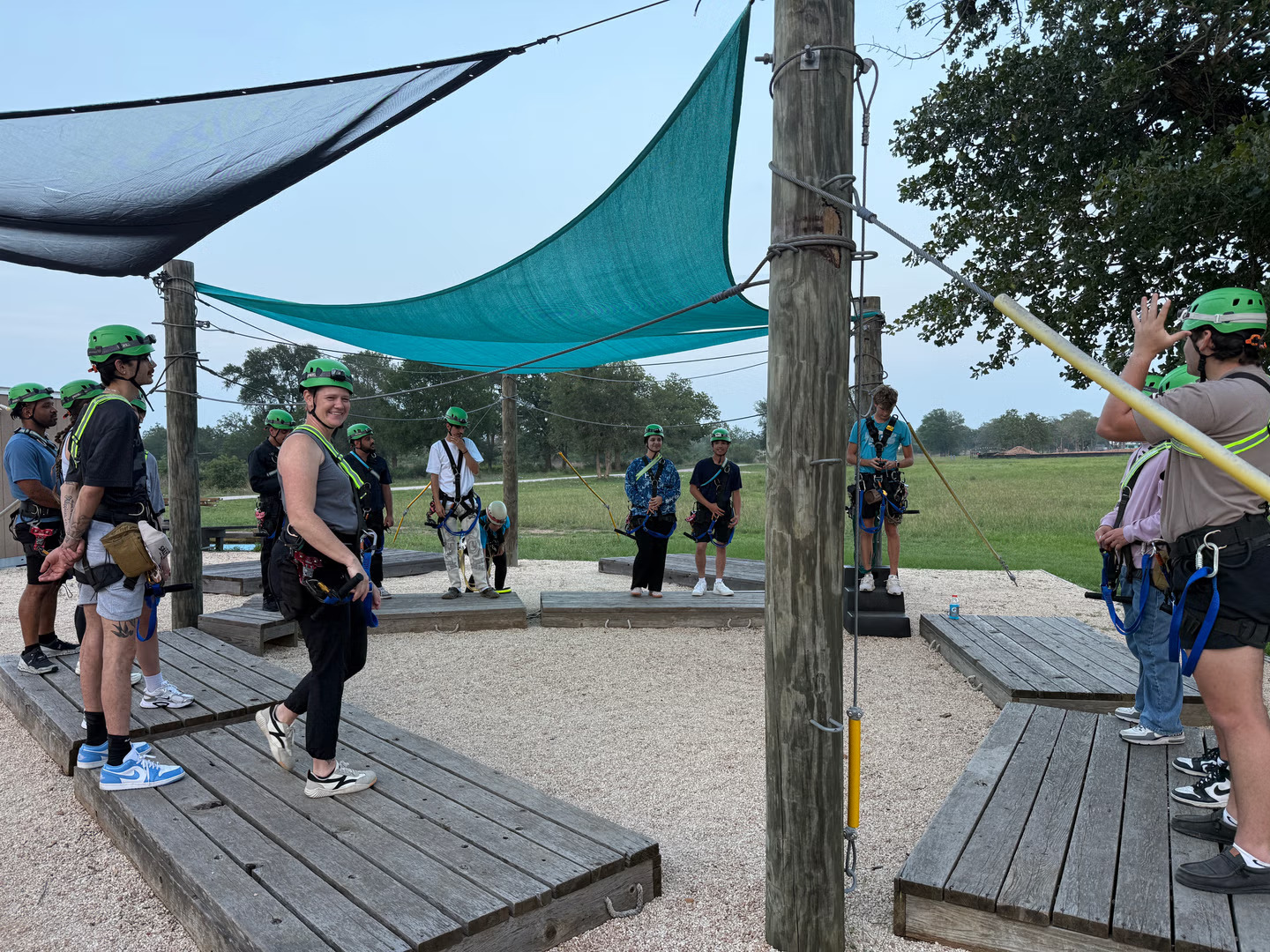
If you are comparing team building activities in Austin teams can genuinely enjoy, start with one question: will your coworkers actually want to participate?
At Zip Lost Pines, you can build the outing around dual zip lines, sky bridges, trail sections, friendly competition, and time together at Base Camp. You are giving your team something to experience together instead of asking them to sit through another structured exercise.
For groups of 10 or more, the Group Events process lets you share your date, participant count, age range, event type, and special requests before the outing.
Here are seven ways to use the experience with your team.
1. Race Side by Side on Dual Zip Lines
Best for: Friendly competition
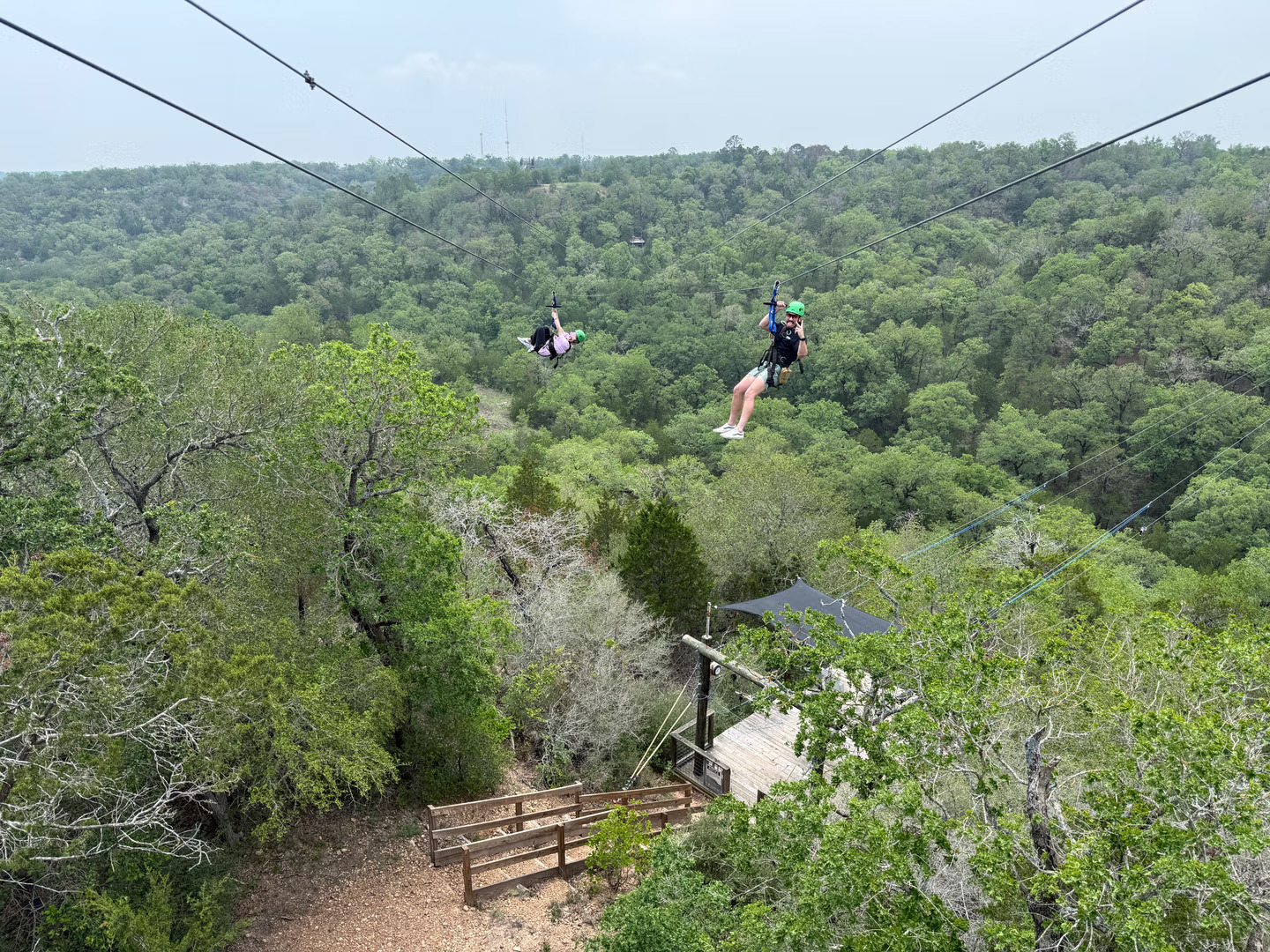
Dual zip lines let two coworkers ride beside each other. You can pair people from the same department or mix employees who rarely work together. Keep the matchups simple:
- Sales vs. operations
- Managers vs. team members
- New hires vs. longtime employees
- Cross-department pairs
- Random teammates
Do not make the result matter. The useful part is watching how people respond outside work. The quiet coworker may become competitive. The person who usually leads every meeting may suddenly want someone else to go first. Those reactions give the team something natural to laugh about afterward.
2. Rotate Partners Across the Course
Best for: Getting departments to mix
If your goal is better interaction, do not let everyone stay with their usual work friend all day. Change partners between lines when the tour flow allows it. A designer may end up beside someone from finance. A new employee may spend part of the course with a manager they have only spoken to briefly.
You do not need conversation prompts. Once two people have just ridden a zip line together, they already have something to talk about. For team building activities in Austin companies use to bring departments together, simple partner rotation can be more natural than forcing a networking exercise.
3. Take on the Full Course Together
Best for: A longer shared experience
The Full Zip Tour takes about two to three hours. It includes five dual zip lines, three sky bridges, spiral stairs, trail sections, and a short group hike. That gives your team enough time to settle into the experience.
The first few minutes may still feel like coworkers attending a company event. After several lines and course sections, people usually have more to react to and discuss. For many first-time riders, the Full Tour also gives a more gradual introduction. That matters when your team has mixed confidence levels. You do not need everyone to arrive equally comfortable with heights.
4. Use the Sky Bridges as a Non-Racing Challenge
Best for: Teams that do not need constant competition
Not every challenge needs a winner. The Full Tour includes three sky bridges, which change the pace between zip lines. You may see completely different reactions here. Someone who looked relaxed on a zip line may slow down on a bridge. Another person may naturally encourage the coworker behind them.
Do not turn every reaction into a leadership lesson. Let people handle the challenge in their own way. Good team building activities in Austin are where the teams often work because coworkers get to see each other outside their normal roles, not because someone explains what each moment is supposed to teach them.
5. Use Trail Time for Actual Conversation
Best for: Informal team bonding
Your team does not need adrenaline every minute. Trail sections and the short group hike give people time to talk between the bigger parts of the course.
This is useful if coworkers normally communicate through email, Slack, or scheduled meetings. Walking beside someone removes much of that structure. Do not fill the trail time with assigned discussion questions. Let conversations happen. A shared activity has already given everyone enough material to start talking.
6. Leave Time for Base Camp
Best for: Relaxed social time
Do not end the event the second the ziplining stops. The Corporate Events setup includes Base Camp areas and yard games, giving your team somewhere to spend time before or after the course.
You can use that time for:
- Yard games
- Food
- Group photos
- Informal department challenges
- Relaxed conversation
- Simply sitting down after the course
By this point, you do not need an icebreaker. Everyone has just shared the same outdoor experience. If you are looking for team building activities for your employees to actually enjoy, resist the urge to schedule every minute.
Leave some room for people to talk.
7. Build the Event Around Your Team’s Goal
Best for: Groups of 10 or more
Before you plan the outing, decide what you want from it. Are you trying to:
- Mix departments?
- Celebrate a milestone?
- Give a new team time together?
- Add friendly competition?
- Get everyone outside?
- Give employees a break from the usual work setting?
Your answer should shape the day. For teams of 10 or more, use the Group Events process to provide your participant count, date, age range, business name, event type, and special requests. A 12-person startup and a 40-person department should not be planned the same way.
Which Activity Fits Your Team?
Choose by team goal, not by which part looks best in a photo.
Team Goal | Good Fit |
Friendly competition | Dual-line races |
Cross-department interaction | Rotating partners |
Longer shared challenge | Full Tour |
Non-racing challenge | Sky bridges |
Informal conversation | Trail sections |
Relaxed bonding | Base Camp |
Larger customized outing | Group Event |
You can combine several of these during the same outing.
How Much Time Should You Allow?
Do not look only at tour duration. The Full Tour takes about two to three hours. You also need time for travel, parking, arrival, check-in, orientation, and getting a larger group organized. A practical plan looks like this:
Part of the Outing | Plan For |
Travel | Drive from Austin |
Arrival | At least 20 minutes early |
Check-in | Group organization and orientation |
Full Tour | About 2 to 3 hours |
Base Camp | Optional time afterward |
Return | Drive back to Austin |
Do not schedule an important meeting immediately after the outing. Groups rarely move on an exact minute-by-minute schedule.
How Far Is Zip Lost Pines From Austin?
Zip Lost Pines is in Cedar Creek, outside central Austin and roughly a half-hour drive from downtown under normal conditions. That makes it practical when you want an outdoor team outing without turning it into an overnight retreat. Traffic can change the drive time, so include travel when planning team building activities for companies that want to fit into a workday. Do not ask everyone to arrive exactly at the tour start time.
What Should You Confirm Before the Event?
A good organizer handles practical questions before the team gets in the car.
Organizer Checklist
- Confirm the final participant count
- Confirm who plans to zip
- Review rider requirements
- Share footwear guidance
- Give employees a private way to raise health or mobility concerns
- Confirm required waivers
- Check the weather
- Plan transportation
- Decide whether you want Base Camp time afterward
- Arrive at least 20 minutes early
- Share special requests in advance
Do not ask people to discuss medical or mobility concerns in front of coworkers.
Handle those questions privately.
What Should Your Team Wear?
Start with closed-toe shoes. Choose clothes that suit the weather and allow comfortable movement. You will use trails, stairs, bridges, and a harness during the experience.
Avoid long or dangling jewelry. For the main course, the standard published rider weight range is 50 to 250 pounds. Review the current Zip Lost Pines FAQ before sending final instructions to your team.
Give people these details before the event, not at check-in.
What if the Weather Changes?
An outdoor event needs some flexibility. Rain does not automatically cancel a tour, but thunderstorms, lightning, heavy rain, or strong winds can affect operations.
Leave room in the day’s schedule for possible delays. If you have food, transportation, or another company activity planned afterward, avoid putting everything back to back.
Should Everyone Have to Zipline?
No. Do not use participation as a test of confidence or team commitment. One coworker may be excited immediately. Another may need more information. Someone else may have a health or mobility reason that affects participation.
Treat those differences professionally. The goal is to create a good team experience, not to find out who is willing to do something they are uncomfortable with.
Give Your Team Something to Talk About on Monday
The best team building activities Austin teams remember do not need forced lessons attached to them. Give your coworkers a different setting and something real to experience together. Let them race, walk, encourage each other, and discover who becomes unexpectedly competitive once they leave the office.
By Monday, the important part is not who crossed a line first. It is that your team has something they experienced together. For a group of 10 or more, use the Zip Lost Pines Group Events process to plan around the people who are actually attending.
FAQs About Team Building Activities Austin Companies Plan
Can you plan a corporate team event at Zip Lost Pines?
Yes. Corporate team building is one of the event types available through the Group Events process.
How many people do you need for a group event?
The Group Events process is designed for groups of 10 or more.
Can coworkers race each other?
Yes. Dual zip lines allow two riders to travel beside each other, which makes friendly competition easy to include.
What if some employees are nervous about heights?
Share the course information before the event and avoid pressuring anyone. Different confidence levels are normal.
How long should you plan for?
The Full Tour takes about two to three hours. Add travel, early arrival, orientation, and any Base Camp time you want afterward.
Can you mix employees from different departments?
Yes. Rotating partners between course sections is a simple way to help coworkers interact outside their normal teams.